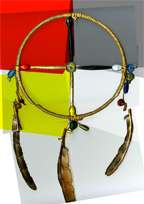
Plains-type Indian medicine wheel or sacred hoop.
The medicine wheel has fascinated me for a long time, although my knowledge of it is cursory. It’s mnemonic device traditionally used by about 3/4 of native American cultures. New Agers have also appropriated it. When I use it in my art I’m not playing Indian or selling New Age. But I am recognizing those cultures as part of the background fabric of my own. In fact, the guy who introduced me to the medicine wheel was a Methodist minister in the Native American Conference. He was also part Cherokee. The medicine wheel, he said, isn’t a part of Cherokee tradition. So, he was learning about it to better relate to the other 3/4s of his congregations and he was sharing what he’d learned with me. I lived in California at the time. The medicine wheel is also not a part of the indigenous California tradition. I’m a native Californian. But not an indigenous native Californian. But I now live in South Carolina just across the border from the Cherokee Rez in North Carolina. But, of course, the medicine wheel isn’t a part of their tradition, anyway. So, the medicine wheel is also not a part of my tradition. Except that now it is.
Basically, I just think it’s cool.
What I like about the medicine wheel – or more properly, the sacred hoop as illustrated here – is that it’s entirely visual and yet indicates almost everything a person needs to know about God, the Universe and Everything. It is not a sacred object, in spite of what it’s called. And, in spite of what it’s called, it has nothing to do with healing or medicine. It’s about spirit and power. A person who “practices” the medicine wheel (there’s all kinds of stories and rituals associated with it, but nothing dogmatic) is a person trying to connect with Bigger Things. Or maybe just be more grounded.
The 4 points on the wheel represent the 4 points of the compass, the “4 winds”. The wheel itself then represents the earth or universe, the physical world. But the 4 points also represent the 4 seasons or the 4 times of day or the 4 ages in a person’s life. So then, the wheel also represents time.
The 4 traditional colors used in the medicine wheel are associated with the 4 times of day or the 4 seasons. They can also represent the 4 stages of life or 4 psycho/emotional states. White represents the light of the sky at dawn or spring. Likewise, white represents birth, purity and new beginnings. Yellow represents mid-day or summer. Yellow also represents youth and vitality. Red represents sunset and autumn. It also represents old age, death and change. Black represents night and winter. Black also represents thoughtfulness, spirit and mystery.
All of these things revolve around and connect the 4 spokes of the wheel to the center. The color here is clear, no color. The center represents the individual who is open to the universe.
The medicine wheel is about time and space and how we try to understand it all; how we use it and how it uses us. But it does not hold the answers. The medicine wheel is more a device that prompts us to ask the questions. It’s about how we move through life in this world.
 art by skip johnston