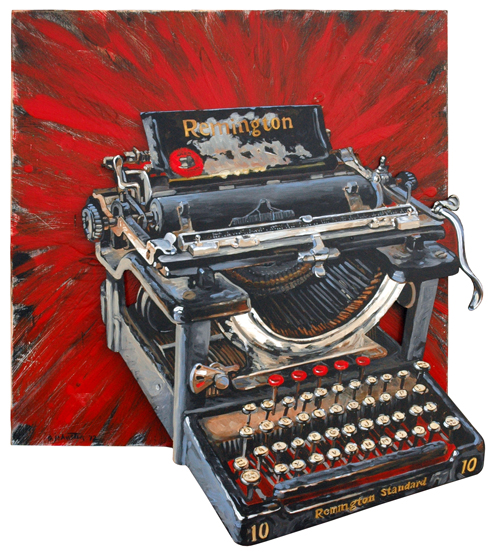
Remington Standard 10, acrylic on board, 27″ x 29″
Not sure where I picked up this bit of Jurassic technology. It’s been sitting around in garages or closets, gathering dust and rust for years. Even moved it across the country. Thing weighs a ton! But something about it has always intrigued my eye. It’s one of those things that are so clunky and ill-proportioned I can’t decide if it’s ugly or beautiful. Or both!
Now that’s a dynamic I had to explore!
I made the image of the typewriter almost twice its actual size. Cut it out of board and positioned it on the background as if it’s falling off, as if it’s too heavy for the background to hold. But it’s not just falling off, it’s jumping forward. The cut out piece is mounted on wedges that angle the bottom out more than an inch to emphasize its forward perspective. The cliché “explosion” pattern, splashed on the background in black and red, helps visually propel the heavy object outward. The background is painted on a piece of used, dinged plywood. The paint is scuffed and scratched. The edges are sanded down to the raw wood. I’ve tried to capture something of the rust, chipped paint, and slightly bent mechanisms in painting the machine. The typewriter is coming out of the background toward the viewer as if both the machine and the viewer are approaching each other. The machine is presenting itself to the viewer, ready for work.
The 1912 Remington Standard 10 was something like the office PC of its day. That was the era of 100-ton steam locomotives, biplanes, and Model T Fords you could get in any color you wanted as long as it was black. That was the time when the Biltmore Estate in Asheville, NC (which we visited recently) was state-of-the-art domestic living. And then some! Most fascinating to me was the working guts of the place in the basement. Hallways led to room after room with all kinds of ingenious, clumsy iron and steel devices, cousins of the Remington Standard, which were tended by a hierarchy of domestic workers. I realized that, 100 years ago, people had rooms for things we now have countertop appliances or virtual desktop apps. It was a time for hard work, grand gestures, and steel.
The Remington Standard 10 isn’t just a quaint thing from a while ago. It’s the expression of an attitude. The open sides blatantly display its working guts. Its maker was proud of his work and wanted those who used his tool (then, increasingly women) confident in theirs. Today we wrap our machines in slick, even customizable surfaces. Beauty is in how they look. Every pin and screw, armature and cast steel support on the Remington is exposed. Its beauty is in how it works. (To see a 1911 version in action, click here.)
“Remington Standard 10” has been juried into the 2012 Artists of the Upstate Exhibition (part of Artisphere 2012). It will be on view at the Centre Stage in downtown Greenville through June 19.
 art by skip johnston