Much of the Lanneau-Norwood House’s anachronistic charm is in her decorative details. The architect ordered these details on a solid, well-proportioned structure. Befitting the era in which she was built, the House is a symphony of patterns and variations on a theme. I intend for the finished piece to have a painterly quality. I’m not trying for photo-realism. I want it to look like a painting. But, at the same time, it will be a painting of a building with complex detail. The underlying structure must be solid. A few sloppily placed details and the whole thing could resemble a melting wedding cake! A tight under-drawing is necessary to loosely apply paint.
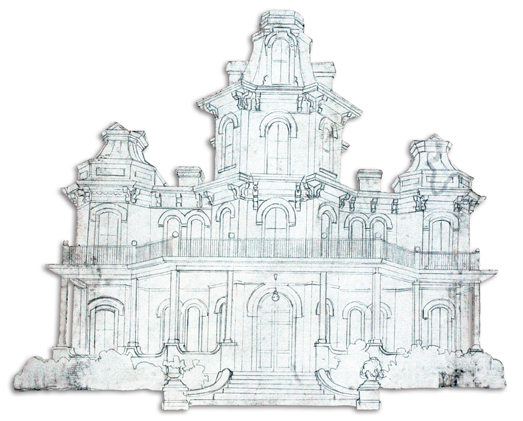
Pencil under-drawing on cut out board.
But not too tight. An architect once interviewed me to do some architectural renderings. The “interview” was a small assignment to produce a drawing of an apartment building from his plans. The architect smiled when I presented my results. “You’re a good artist,” he said. “But not an architectural illustrator.” I was a little too expressive with the building’s surrounding foliage and had stretched the perspective a bit for dramatic effect. An architectural rendering is all about conveying accurate information. I want to be accurate with the Lanneau-Norwood painting but also evocative. There will be a slight bug’s eye, three-point perspective to the design as if the viewer is standing on the walkway leading to the front door. I want something of the design and detail that make the House a masterpiece of its style seen but I also want the eye welcomed in to wander around the painting as a guest.
So the accuracy of the under-drawing is important (or at least appear accurate). Yet it can’t be so restrictive as to make the final paint application a rote paint-by-numbers exercise.
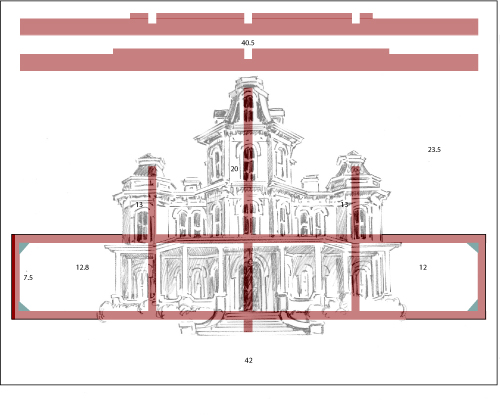
Plan for the painting’s support structure.
The process of designing, cutting out the dimensional pieces, building the physical structure to hold the painting, and producing an accurate under-drawing of the House feels like half the project. Yet not a schmere of color has been applied. Let the fun begin!
 art by skip johnston