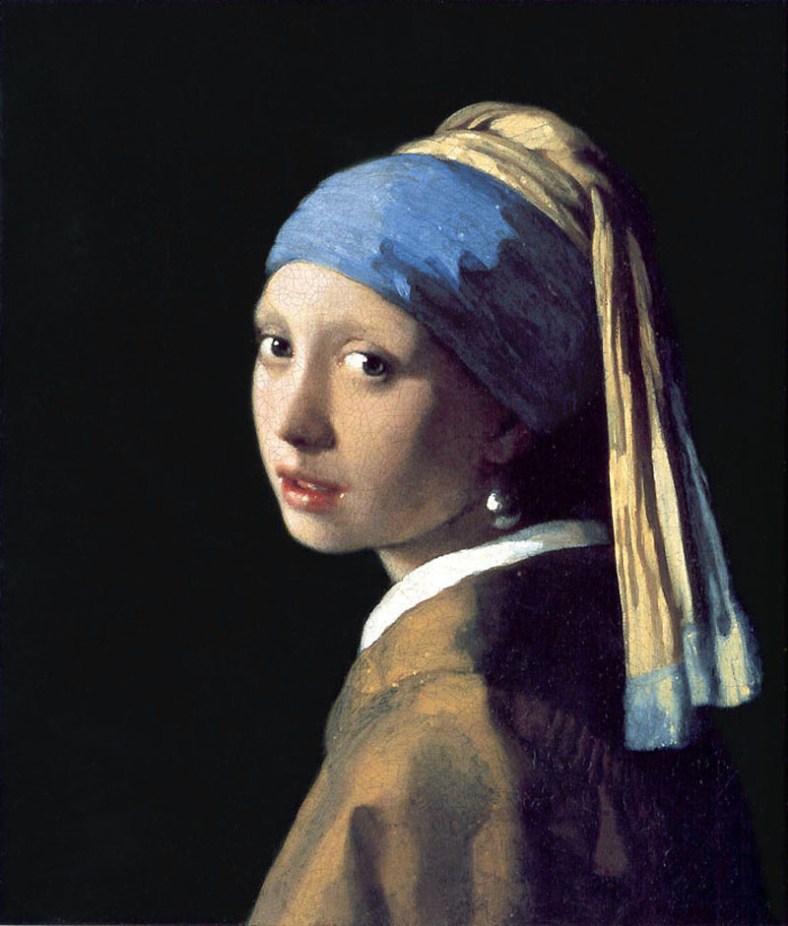
Girl with a Pearl Earring, Mauritshuis, The Royal Picture Gallery, The Hague, The Netherlands
Taking apart the engine of a painting to see how it runs is just plain fun for an art nerd. I love the design of Girl with a Pearl Earring. It’s simple, yet complex—“simplex”, as a designer friend of mine used to say, giving the word a whole new definition. Vermeer’s painting is an elegant composition.
The painting seems to catch a spontaneous moment. It’s as if I’ve interrupted the girl and she’s turning toward me as I approach. She’s un-posed. Yet the painting is well designed. The artist seemingly has carefully posed her.
(I say “seemingly” because little is known about Vermeer’s working process. His genius—and my lack of genius—aside, I’m looking at this painting as an enthusiastic amateur.)
So, how, as it seems to me, has he posed this un-posed picture?
Artists have known since forever that we can’t help but look at the eyes in a painting. It’s how we’re hardwired. We look where the eyes look. And if those eyes are looking back at us, the effect is powerful. The girl’s eyes are the center of attention in the painting.
But I’m not just looking at a picture of a girl looking out at me. The artist tricks my brain into seeing a real girl in the room with me. That’s the fun of representational paintings. The artist sets up a mental ping-pong game between what I see and how I see it. I know I’m looking at paint on a flat surface. But my eyes see 3-D. An artist’s skill lies in knowing how the eye works with the brain. This is true in abstract art as well as representational. In the case of Vermeer, that skill is monumental.
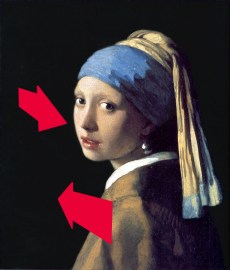
The illusion of depth is enhanced by an implied movement of the girl in space.
The artist has created an illusion of depth. He’s set the pale warm colors of the girl’s face against the seemingly infinite space of the cool black background that surrounds her. Generally speaking, warm colors appear closer than cool colors, light colors seem nearer than dark. Vermeer uses the warm/cool, light/dark contrasts to imply the figure’s dimensionality . She seems to stand away from the background. It’s as if the girl is in the same space I am. He’s enhanced the illusion further by having her shoulders face away even as her head turns toward me. She’s occupying space, my brain reports.
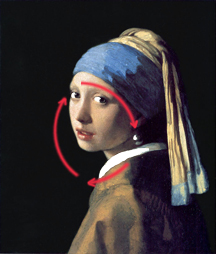
The strategically placed highlights set against the darkest darks keeps our eyes circling the face.
The most radical light/dark contrasts in the painting are between the black background and the smaller points or patches of pure white in the eyes, the pearl and on the collar of the girl’s gown. Because her head is at an angle, the white of her right eye immediately juxtaposes the black. This is the ultimate contrast in the painting. It’s the hardest “slam” in my mental ping-pong and brings my eyes to hers.
Our eyes move about automatically. Each eye independently sends several slightly different images to the brain each second. It’s how we see in 3-D. The artist guides my eye movements from the highlights in her eyes to the highlight on the pearl. Surrounded by dark values and painted next to the deep black of the shadow’s core further emphasizes this highlight. The oversized pearl is very near the center of the painting and serves as something of a visual pivot point. From the pearl, my eye slides down the slash of white on the collar where it slams, once again, into the deep background. This hard contrast grabs my eye and returns it to the black/white contrast at the girl’s right eye. The path my eyes take around the painting is continuously brought back to the girl’s eyes.
Other contrasts enhance this circular visual motion. The simple relatively straight edge of the scarf hanging down the girl’s back contrasts with the complex silhouette of her front profile.
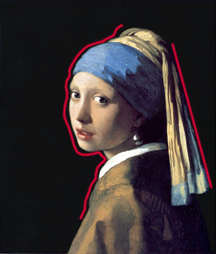
The relatively flat silhouette of the scarf at the back of the girl’s head plays against the her active front profile.
The beautiful pale blue on her turban compliments the yellow around it and on the scarf as well as the ochre of her gown. Various angles created by different elements “open” from right to left like a megaphone with, once again, her eyes near center. Vermeer’s brushwork near her eyes and on her face is invisible. But at the edges of the turban, scarf and gown, he has applied the paint in loose strokes. In effect, I’m forced to focus on her eyes while everything on the periphery blurs—just as it does when seeing a real object.
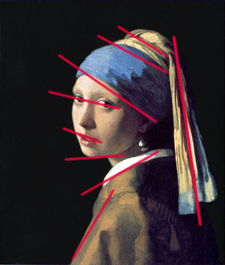
Visual angles open to the left while the more vertical angle of the scarf stops our eyes at the right.
All of these ping-ponging contrasts work simultaneously to simulate how I see things in 3-D reality. Vermeer has mastered the complexities of sight. His understanding of how light works and how the eye perceives it is astounding. Yet his application is sparing, simple, elegant.
But just as taking a car’s engine apart doesn’t equal the thrill of driving it, how I see a painting is only the set up for what I see. I don’t think Vermeer is continually leading me to the girl’s eyes just to show off his technical skills. What I see there is what’s given this work its irresistible force.
It’s here, I think, we join Vermeer at the point of artistic creation.
 art by skip johnston