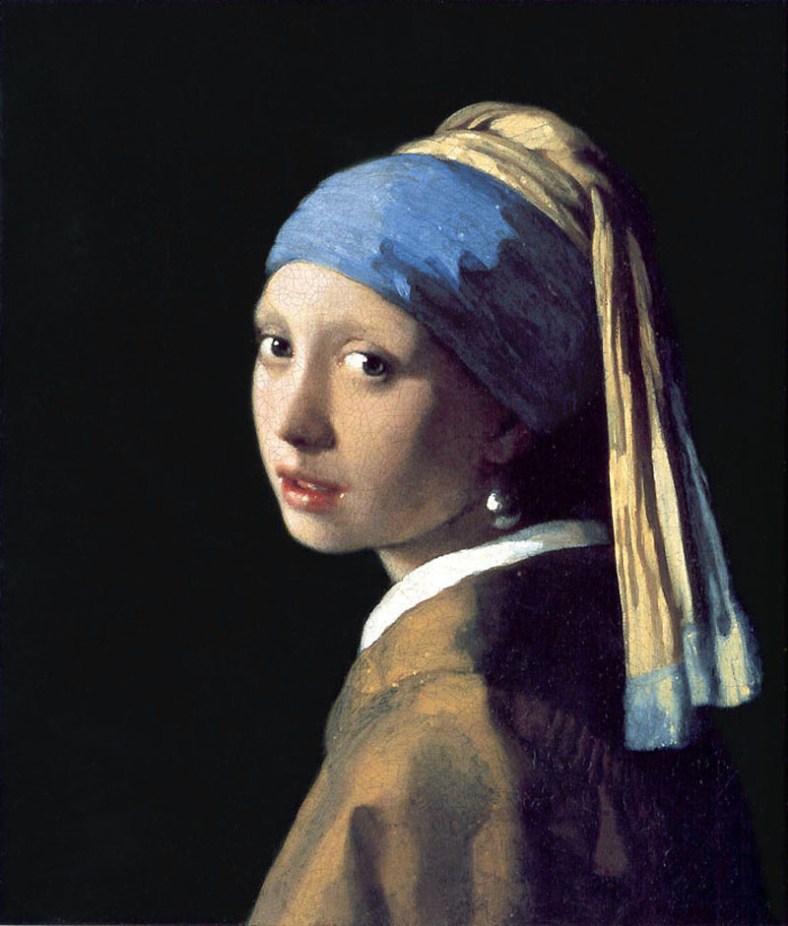
Girl with a Pearl Earring, Mauritshuis, The Royal Picture Gallery, The Hague, The Netherlands
I once went to an art show where the artist gave a little talk about his paintings. In the Q&A that followed, a young woman with a very thick binder stood to ask a question. She didn’t so much ask a question as she offered a long rambling interpretation of one of his paintings. Her question, when she finally got to it, was whether or not the artist agreed with her assessment.
“Wow!” the artist said. “I never thought about that. I just thought it was a cool image.”
What we see in a work of art, what draws us in and resonates with us may or may not have anything to do with what the artist intended. Art history blogger Hasan Niyazi writes, “Our experience of art is invariably personal, and undoubtedly subjective. How we process a painting, sculpture or film is dependent on myriad factors from our own past and present, and includes elements of prior knowledge and experience of language, images and sound. ”
The artist creates the piece. We create its meaning.
Girl with a Pearl Earring is the perfect work on which we might project our interpretations. Other than what’s recorded in a few official documents, not much is known about Jan Vermeer. Virtually nothing is known about Girl with a Pearl Earring. We don’t know who the girl is or even if she was a real person—although presumably, someone sat for the painting. It is not a portrait. It’s what in those days was called a tronie. Tronie means face or head and was a popular genre in 17th C Dutch art. It’s a character study, an interesting personality to look at, not necessarily the rendering of a specific person. Rembrandt painted dozens of tronies in the day. He often used himself as the model, wearing various hats or helmets and costumes. The girl in Vermeer’s painting wears a turban and gown that were not typical Dutch dress. She would have appeared exotic to The Netherlands of the mid-1600s. The eponymous pearl is larger than a real pearl and is perhaps a piece of glass costume jewelry or pure invention by the artist. We don’t know.
What we do know is those wonderfully painted liquid gray eyes grab our attention with an urgency few works of art do. Girl with a Pearl Earring engages us directly with her eyes. It is a visual invitation to project our own thoughts and feelings.
That’s the fun and fascination with this painting. We get to say who she is, what she’s doing, what she’s thinking or feeling. Having fooled the visual part of our brain into seeing a real person, Vermeer sets up a relationship with the girl.

Girl with a Pearl Earring (film) Source: Wikipedia Commons
Tracy Chevalier wrote a novel based on her interpretation of the painting called, unsurprisingly, Girl with a Pearl Earring. It was made into a movie of the same name starring Scarlett Johanson as the girl. Ms. Chevalier said her fascination with the painting began at 19 when she hung a poster of the image in her bedroom. In her story, the girl, Griet, is a servant in the busy household of Jan Vermeer, the painter. Attracted to her quiet, sensitive manner, the artist uses her as his assistant and, eventually, his model. As their intimate working relationship grows, the artist, through his uncanny powers of observation, captures the girl’s increasing infatuation with him in the painting. Ms. Chevalier said, the young woman’s sensually parted lips and hooded eyes are evidence of her romantic feelings. She sees in the painting a young woman looking back at the man with whom she’s falling in love.
It’s a nice story. And the movie gives a believable picture of 17th C Holland.
But it’s fiction.
My interpretation is different.
Turns out, Jan Vermeer and I have some things in common. We’re both artists and, according to my grandmother, I have some Dutch blood. Of course, I’m as near the caliber of artist Vermeer is as I am to speaking Dutch. But we share something else. We’re both the father of daughters.
Vermeer had a daughter, Maria, about 13 when he painted Girl with a Pearl Earring. Some have speculated that she was the model. Tracy Chevalier identifies with the girl in the picture. I identify with the painter. There’s something familiar to me in the girl’s expression… and it’s not sensual desire. Thinking about this, I realized the expression on the girl in the painting is one I had seen on 13 year-old daughters before: boredom. As an artist, I could imagine asking one of my young daughters to sit for endless hours as I painted her picture. Merely asking the question would have elicited just that dismissive facial response—the look. And the way he precisely staged the pose, her head turned back looking over her shoulder, would have after some time, resulted in her jaw slackening and her eyelids relaxing to half mast.
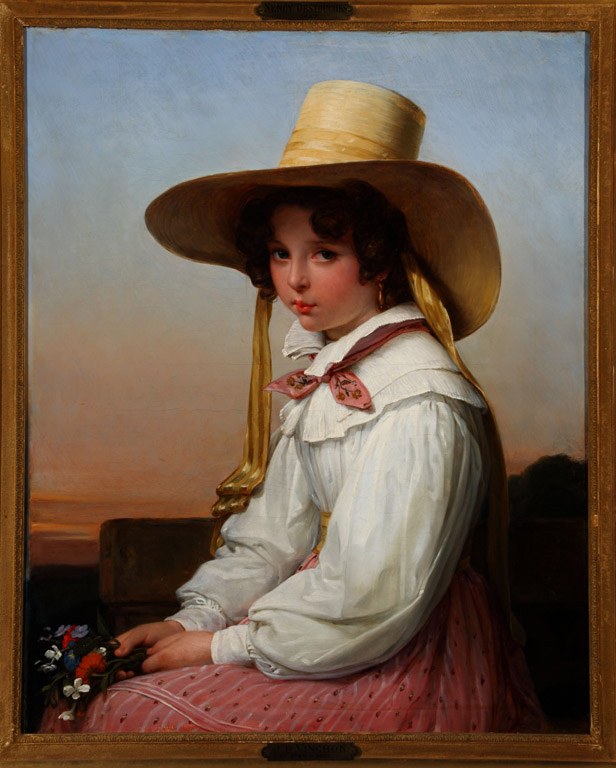
Auguste-Jean-Baptiste Vinchon, Portrait of Nancy Destouches, 1829, High Museum of Art, Atlanta
Wandering around the High Museum, I came across a painting done in 1829 by the French Classisist, Auguste-Jean-Baptiste Vinchon called Portrait of Nancy Destouches. Young Nancy is about the same age as Maria, when her father painted Girl with a Pearl Earring. Sweet as Portrait of Nancy Destouches is intended, sure enough, there’s that bored look in the girl’s eyes.
Tracy Chevalier and I are looking at the same painting, seeing the same visual cues painted there by the artist. Yet, because of the “myriad factors from our own past and present”, the meaning we give the painting is very different.
But I see more in Vermeer’s work than adolescent tedium. If, as I’m projecting, this is the artist’s young daughter, so exquisite is his talent at seeing and transferring what he sees to canvas, he’s revealed the tender heart of their relationship to a startling degree. Beyond the boredom, I see the girl’s childlike fear of parental authority and the respect she holds for that authority. She has no choice but to obey his demands and yet, at the same time, he has brought her into his world and given her an important part. The girl isn’t looking into my eyes, she’s looking into the eyes of the man with whom she shares a complex and elemental relationship. It is Vermeer’s genius that I look back not with my eyes but through his at his child. In his spare rendering of her face, he’s recorded the intricate bond between father and daughter and something of the frightening dynamics of that love.
Maybe this says more about me than anything the artist intended. My interpretation may be as fictive as Tracy Chevalier’s more entertaining rendition. Maybe Vermeer just thought it was a cool image. But isn’t this interactive play of imaginations the reason for making and enjoying cool images?
 art by skip johnston