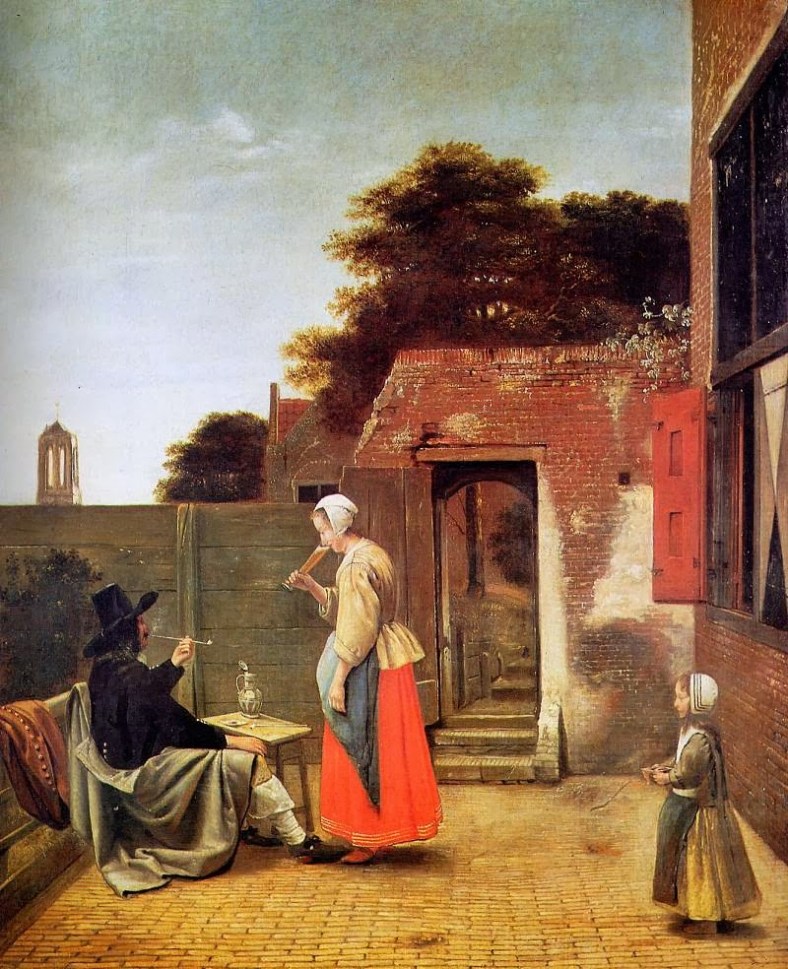
A Dutch Courtyard, 1658-1650 by Pieter de Hooch, Mauritshuis, The Royal Picture Gallery, The Hague, The Netherlands
Sometimes you see things you don’t know you’re seeing. Or, as with the painting above, I didn’t see things I didn’t know I wasn’t seeing.
This was one of the paintings that caught my eye when I visited the High Museum’s show of 17th C Dutch art in Atlanta a while back. It’s a genre painting by Pieter de Hooch.
The painting depicts a successful young man enjoying some downtime in the courtyard of a tavern. His blue-aproned “server” is entertaining him by playing a drinking game, as 17th C Dutch bar maids were expected to do. Another very young servant girl is bringing a container of hot coals to light his pipe. Everything in the painting contributes to the feeling of contentment, relaxation and peace.
Except something about it bugged me. I spent a lot of time at the museum staring at it. Then I bought the catalog and spent a lot more time staring at its reproduction in the book. Visually speaking, something didn’t add up. But I couldn’t quite put my finger on it.
Seventeenth century Dutch artists had absorbed everything the previous couple of centuries of Renaissance painting offered. And then brilliantly added more. They, perhaps more than anyone else on the planet then, understood how to construct a painting. Everything was deliberate, everything planned out.
It took me a while to figure out the problem.
When looking at the painting, you don’t have to be a Rembrandt to figure out the couple is the center of attention. They’re what the painting’s about. But why? What makes that so? In representational art, our eyes will naturally land on anything human first.We look for the eyes in the painting or the direction the eyes are looking. It’s the way we’re wired. We want to see what people are up to. In the case of this painting, the eyes of the couple are on each other and the little girl on the right looks toward the them (#1. below). We just naturally follow their lines of sight. Additionally, the artist has made the brightest hued passage in the painting the woman’s skirt and the darkest the man’s jacket and hat. This visually reinforces de Hooch’s idea that the couple is the center of attention.
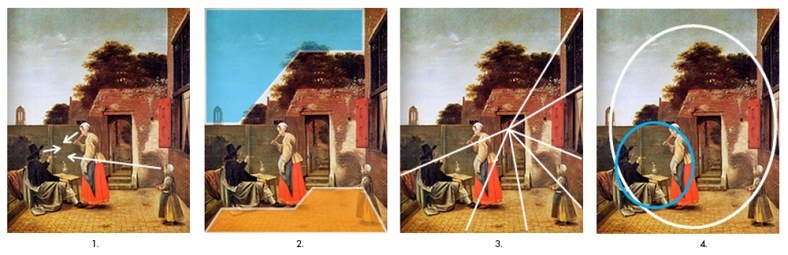
He does other things, too. A proportionately large area at the top of the painting is given over to the soft cool colored sky. Similarly, a repetitive and therefore soothing pattern of warm-toned pavers occupies the bottom area. Notice that these somewhat “L”shaped areas (#2) are mirror images of each other with the one on the bottom being “laid down” in perspective. Together they function something like a yin-yang spiral around the painting’s center, just behind the woman.
If we follow the one-point perspective lines (#3) from the building on the right, the vertical edge-lines of the pavers and the rails of the fence on the left we see that they converge near this same central spot at the middle of the tree trunk glimpsed through the garden doorway. By balancing our attention near the painting’s center, the artist helps us to feel the calm mood of this pleasant little scene.
But the center of the painting and the center of our attention are not the same (#4). If that were so, the work would be in danger of becoming as boring as a target. There’d be no place for our eye to go once we got to the center. So the artist sets up a dynamic that keeps us visually moving back to the couple. He does this in several ways. The little girl on the right, along with the strong vertical of the wall that visually rises from the top of her head, stops our eye from wandering off the right side, balancing the couple offset to the left. And, as I’ve noted, the little girl’s gaze takes us back toward the couple.
Directly above the girl is a red shutter, similar in color to the woman’s skirt. This color and the perspective lines of the shutter, leads the eye back to the woman. And then there’s a kind of secondary yin-yang spiral set up by the figure of the little girl and the starkly silhouetted church tower seen over the fence. The center of this spiral is on the woman.
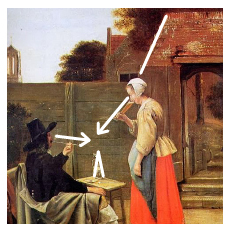
All lines lead… nowhere?
So, the artist is continually bringing the eye to the woman. But it doesn’t end there. Her line of sight leads us down the edge of the tall glass she’s holding (diagram at left). This is further reinforced by the edge line of the wall up behind her head. When we follow this line, it takes us to a spot near where the man’s line of sight ends along his pipe. The pear-shaped vertical of the drinking stein on the table further emphasizes this spot. But all of this points to… nothing. The whole painting seems designed to direct our eyes to a space between the man and the woman. Once there, there are no visual cues to take us elsewhere.
That’s just wrong! My eyes picked up on this wrongness and left me feeling a bit queasy long before my brain figured it out.
Okay, the painting is still delightful and de Hooch is still a Dutch master. But surely he knew better than to take us to a visual dead-end. I was bugged enough to do some research. If I were more of a detective than an art nerd, I might have caught the clues. Do you see them?
There’s an extra red cloak draped over the fence behind the man and an extra pipe on the table. It makes all kinds of sense that de Hooch painted out a second man, sitting in the nothingness where all lines converge. I imagine that whatever cues this figure could give us would enhance our visual interaction. De Hooch would’ve given us something interesting, something that would’ve kept the eye moving about this convivial little group. Which is the point of the painting—a nice time with friends at the pub. That supposedly missing figure would give a satisfying conclusion to experiencing the painting.
Why did he paint out the figure? Who knows?
Pieter de Hooch was in the painting business to make money. No doubt he did what he had to do so satisfy a client. Sometimes he did several versions of the same painting for sale.
And so it is with this one.
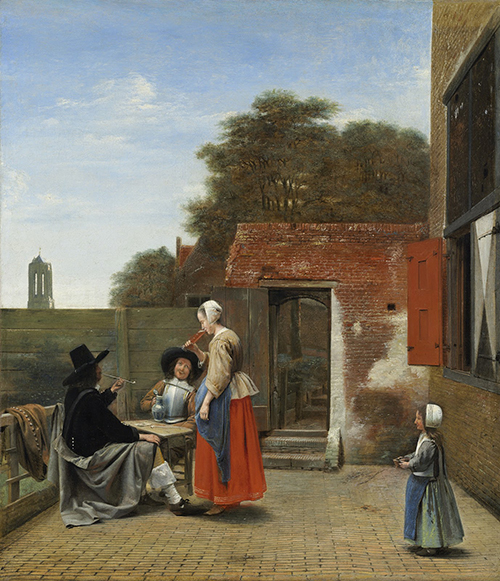
Another version of A Dutch Courtyard 1658-60, by Pieter De Hooch, National Gallery of Art, Washington, DC, USA
 art by skip johnston