August 7, 1942
The intrigue of images, particularly photographs, is in their ability to catch and freeze a moment. When the moment captured is the instant everything changed, the image can be very powerful.
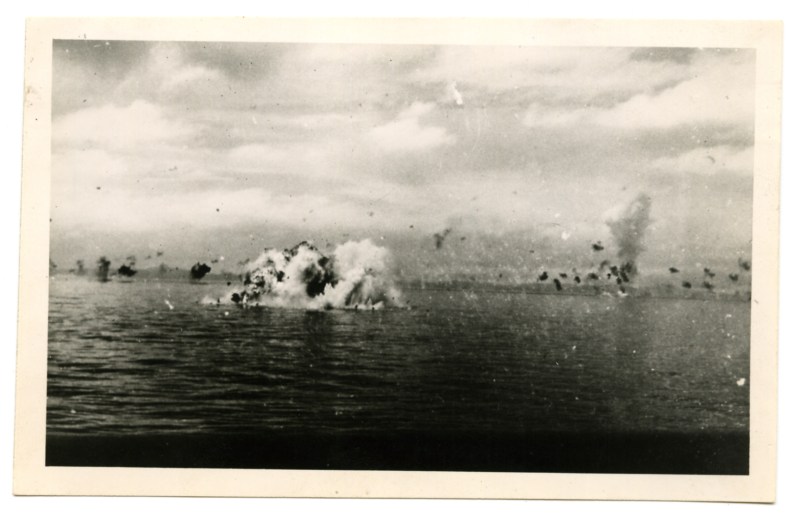
So far as I know, only a few in my family have seen the photo above. It is a very personal image. I think it may also have some historical value. I did not see this photo until a few years ago. It fell from the crumbling, yellowed pages of Mom’s haphazardly kept scrapbook. On the back of the photo, Dad wrote her name in pencil: Bette.
I heard about the photo from Mom when I was a kid. She must have spent some time describing it because I’ve carried an imagined image of it all these years. She told me it showed a splash, far away on the ocean. Until a few years ago, the image I carried in my head was of the calm horizon of the Pacific with the faintest wisp of spray lifted into a clear sky. I don’t remember asking to see the photo then, but I probably did. And probably, she told me that it “was around here somewhere” but it was too much bother to look for just then. So I carried the imagined image of the photo around with me and lost interest in seeing the real thing.
I learned pretty early that Dad wouldn’t talk about the war. He loved the Navy but hated the war. I also learned that this silence was common among war vets. James Hornfischer in his account of the U.S. Navy at Guadalcanal writes, “…the experience of battle forever divides those who talk of nothing but its prospect from those who talk of everything else but its memory.” I understood as a kid that those memories were better left stuffed away “around here somewhere”. Dad wanted me to grow up with my own memories; not be too concerned with rummaging around in his. And so my image of Dad at war was a wisp of spray on a far horizon.
And then I found the photo. At first I didn’t recognize it. It looked nothing like the familiar old image in my head. I even put it back in the yellowed scrapbook and forgot about it. But one day, for reasons I’ve also forgotten, it occurred to me that this photo was the photo.
I remembered some of what Mom told me about it. She received the 5” x 3” photo in an envelope in the fall of 1942, or maybe early 1943. There was nothing else in the envelope. No note; just the photo with her name written on the back in pencil. To dodge the ever-present mail censors, Dad devised ways to tell his (then) fiancé where he was and how he was doing. This was usually accomplished with postcards and other touristy things sent from various ports around the edge of the Pacific War. She was used to getting cryptic messages from him. But this enigmatic photo was different. It was a puzzle. She would not find out its meaning for a long time.
As best as I can piece together the details, the photo was taken at about one o’clock in the afternoon, 72 years ago today, August 7, 1942. In the background is Florida Island, across Skylark Channel from Guadalcanal Island. It was taken, Mom said, by a photographer for Life Magazine who was aboard Dad’s ship, the USS Crescent City, an attack transport.
At a little after 6:00 am that morning, the invasion of Guadalcanal had begun. There were two landing sites: one near the Japanese airfield under construction on Guadalcanal Island and the other, across the channel near the Japanese HQ on little Tulagi Island, nestled in the bay off Florida Island. The Crescent City, was among the transports landing Marines on Tulagi. It was the first time the Americans had taken the war to the Japanese. And the Japanese were caught, as they used to say, flat-footed.
In the photo, you can see heavy clouds breaking up. This cloud cover had kept the invasion hidden from discovery by Japanese aircraft. But as the clouds dissipated around 1 pm, 54 planes of the Japanese 11th Air Fleet, swooped in low across the water. A coastwatcher warned the American fleet of their approach. The Marines in their amphibious landing craft had been able to get to shore. Those Marines still on the Crescent City were held below decks, trusting their lives to the accuracy of naval gunners. The transports gathered in the middle of a great defensive circle of cruisers and destroyers. The Crescent City and its contingent of the 2nd Marine Division were prime targets.
A Mitsubishi medium bomber made it through the outer defensive ring of ships and headed for the Crescent City. Dad and his number one gun crew on the ship’s bow fired and wounded it. The Jap plane lead a trail of black, greasy smoke as it crossed in front of the bow, and made a long, slow circle back around for a second attempt. As it approached again, the number one gun hit it again and again. The plane stuttered and plunged into the sea. At that instant, the photographer released his shutter.
This was the first enemy plane downed at Guadalcanal. Eight months to the day after the attack on Pearl Harbor, it was the first Japanese plane shot down as America took the offensive. Everything changed after that.
Look at the photo again. It captures the instant three men are dying. Everything is changing. Dad is instrumental in those deaths. I think in that moment Dad changed, too. How could he not? Yes, it was war. Yes, those three Japanese aviators were intent on killing him had he and his crew not shot true. Of the five Japanese planes shot down on that day; four were shot down by gunners on the Crescent City. I look at this photo now and remember the image I carried in my head for so long and the ideas I had about my parents before I was born. And everything changes. World War II was a planetary tragedy; a personal catastrophe.
Mom said the photographer made a copy of the picture he’d taken and gave it to Dad. Dad sent it to his fiancé without comment. What was there to say? Except to write her name, “Bette”, on the back in pencil.
Bette
 art by skip johnston