We toured Frank Lloyd Wright’s Oak Park home and studio during our recent visit to Chicago. He built it in the late 1880s and lived and worked there until 1909. After subsequent various uses and considerable neglect, restoration began in the 1990s. Today, it’s maintained by the Frank Lloyd Wright Trust and is open to the public. For me, it’s always a treat to see someone’s creative work. Doing so sets up a kind of conversation with areas of their personality often obscured by their public persona. (From what I know of Mr. Wright, he’s not exactly the kind of guy I’d want to hang out and have a beer with.) This house, built during the Craftsman era, is warm and cozy, dressed in various woods, stone and stained glass. He was obviously experimenting with different architectural ideas. This makes the place fun and quirky and, well, creative. And a cool place to sketch…
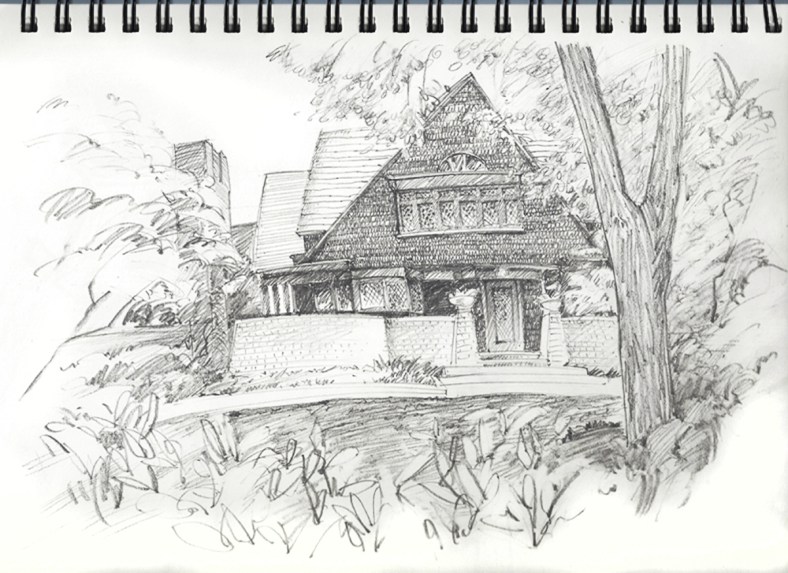
Pencil sketch of the west face of Frank Lloyd Wright’s Oak Park, IL home and studio.
Frank Lloyd Wright put a premium on privacy, almost to the point of seclusion. The front entrance is offset through an opening in a high wall and recessed under the overhanging upper floor. Even with a tour group, you approach quietly so as not to disturb. The front windows are set high in the walls, allowing light to filter in but not the gaze of passersby.
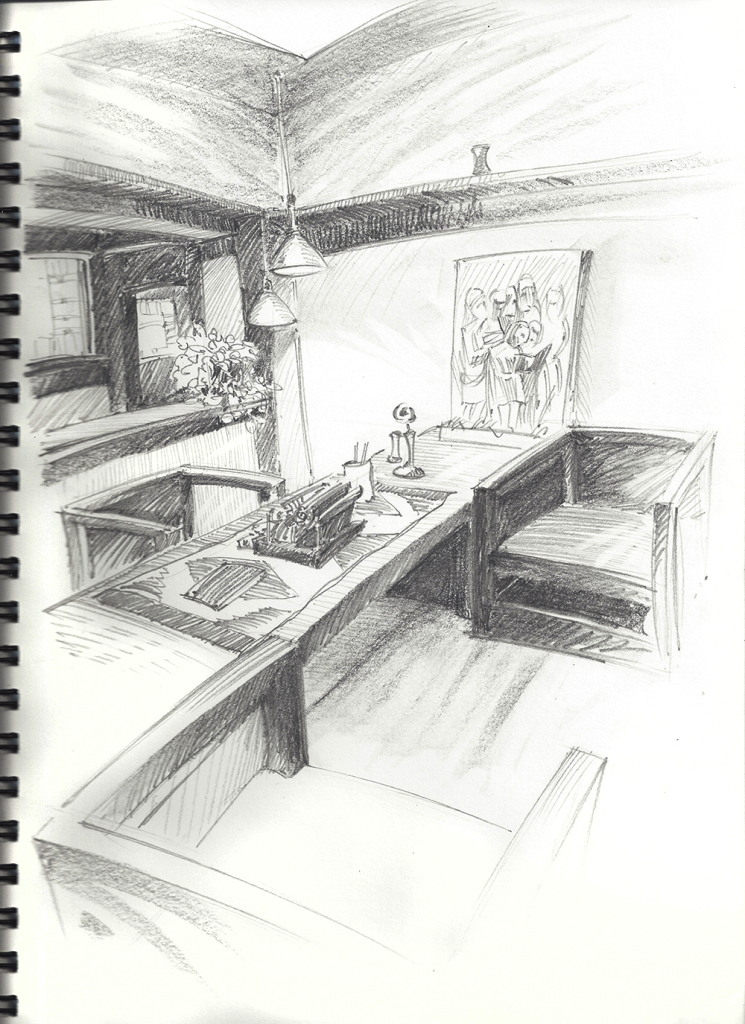
Frank Lloyd Wright’s office.
His office was set up so that no one would be confused as to who was the boss. FLW designed everything, including the furniture and stained glass windows. The chairs in front of his desk for consults with his employees are decidedly uncomfortable and encourage brief visits. (Although they are the same as his own chair. Presumably, they held padded cushions back in the day.) To get to the only worker-accessible restroom, his employees would have to pass by the short wall behind his desk, making the duration of such visits notable. In 1909, the only telephone in the office was on FLW’s desk.
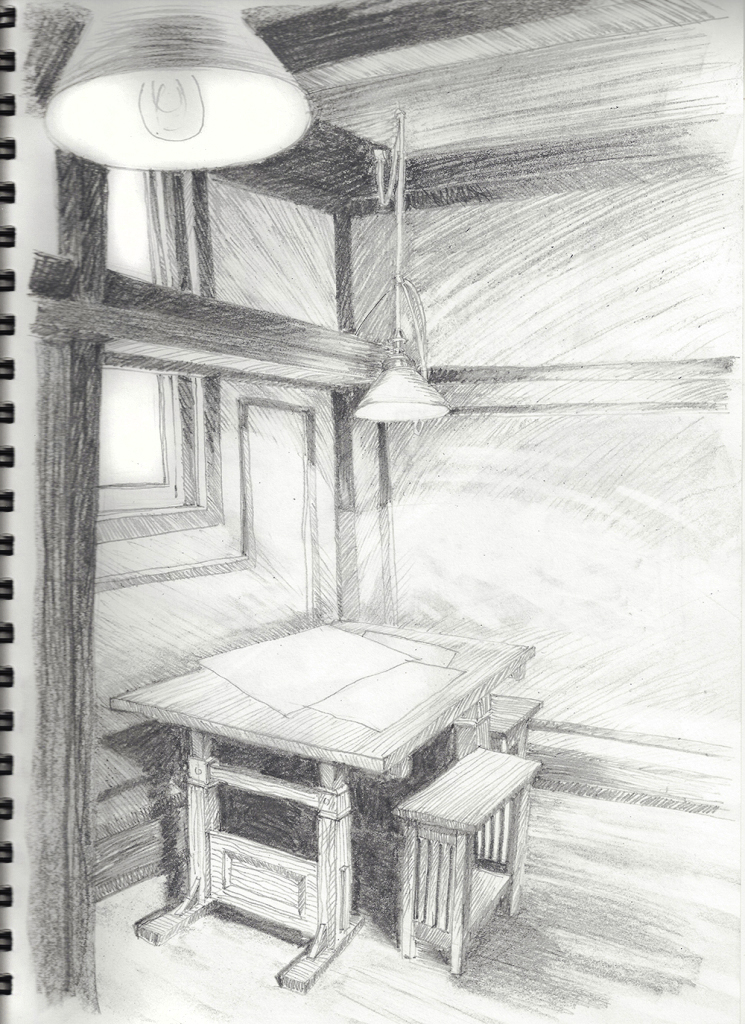
Corner in the drafting room.
The drafting room could accommodate a half-dozen or so architects and draftsmen. Again, FLW designed all the well-crafted furniture. Large, high set windows let in good light and keep prying eyes away from his secretly held projects. All work was locked away at day’s end in a large walk-in safe at one side of the drafting room. This room was open to the second story. A mezzanine encircled the drafting room where an equal number of graphic designers worked at similar work stations. I was struck by how, until the introduction of desktop computers in the late 1980s, design studios had changed little in at least a century. Don’t know if I could have tolerated a boss like FLW, but I could imagine working in his efficient, pleasant office environment.

Kitchen
On the other hand, the kitchen (one of my other favorite work areas) seemed to benefit little at this stage of FLW’s innovative architectural genius. Compared to the ever-so-much-more palatial Biltmore Estate, built at the same time and that purposely incorporated the latest in kitchen technology, this space seemed to be pretty much the standard “farm” kitchen of the day.
But there were many more rooms and areas in this rambling place that served his young family and growing business well. We also took a walking tour of the neighborhood where a dozen or so Frank Lloyd Wright designed homes reside.
 art by skip johnston