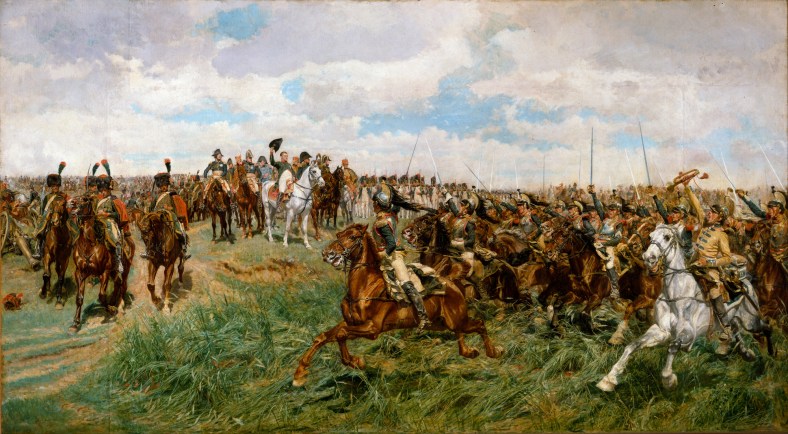
“1807, Friedland”, 1875, Ernest Messonier, Metropolitan Museum of Art, New York
How do horses run?
Who cares?
Today, maybe not so much. But for centuries, even millennia—back when horses were the main source of, you know, horsepower— this was a big question. How do horses run? Do all of their feet leave the ground at the same time? Or does at least one hoof always maintain contact? Do the front legs and back legs extend at the same time (as was popularly depicted, see above)? Do horses pull themselves forward with their front legs or push off with their back? The fact was, despite the very close human/horse relationship for thousands of years, figuring out the mechanics of the gallop was beyond human perception. A horse runs too fast for the eyes to see or the brain to process exactly how it’s done. In order to see how horses run, a whole new way of seeing had to be invented.
Our ancestors had many a lively discussion over these questions and a pint at the local tavern. But it was of particular interest to artists. Painting horses was big business back in the day. Leonardo was famous for his equine renderings. In the 18th and 19th C, great horse painters, called animaliers, were like rock stars, traveling both sides of the Atlantic, filling commissions for canvases depicting prize animals and horse-related events. But when it came to painting a horse running, most artists used the formulas and tropes that had been passed down for generations since caveman days.
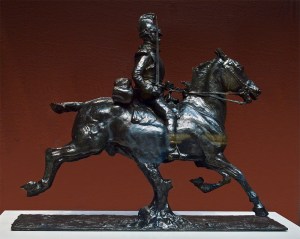
Study for “1807, Friedland”, Chicago Institute of Art. Messonier got it wrong.
A few artists, however, really tried to find the answer. Perhaps the most famous and highly paid such artist was the French painter, Ernest Messonier. Working in the mid to late 19th C, Messonier was much more popular and better respected at the time than his revolutionary Impressionist contemporaries such as Renior or Cezanne. He was a painter of what was called “history paintings”— illustrations, really, of historical events, mostly nostalgic depictions of Napoleon. He was known for doing painstaking research, interviewing the aged participants of old battles and amassing a huge collection of historical artifacts to ensure the authenticity of his paintings. He did hundreds of preparatory sketches and paintings, even small sculptures before committing to the final work. He was known especially for his research into how horses run. In preparation for his most famous work, “1807, Friedland”, Messonier built a small railroad on his estate so that he could ride and sketch on a flatcar as horses charged alongside. He worked on the painting for more than a decade, finally completing it in 1875.
And yet, he got it wrong. Horses run faster than the eye can see.
Even as Messonier was finishing up “1807, Friedland”, on the left coast of the left continent, California’s governor Leland Stanford, a racehorse owner, hired a local British-born photographer, Eadweard Muybridge, to shoot a few studies of galloping horses. Stanford had made a bet on how horses run. In the process, Muybridge pretty much invented the movies. Stanford won his bet, a new art form was born and the world could now see how horses run. Here’s an 1878 series of Muybridge shots compiled into a “movie”: Muybridge: Running Horse

Muybridge set up 12 heavy glass plate cameras in tight inner circle. He constructed a large outer pen with white sheets hanging down. Each camera snapped a shot as the horse ran by.
And yet, although how a horse runs is now long understood and our close relationship with these animals is mostly a thing of the past, seeing a horse run continues to enthrall and inspire…

Mechanical Galloping Horse, 2015, Adrian Landon, seen here at the Kentucky Horse Park
Oh, and don’t feel bad for Ernest Messonier. Although, by the time he completed “1807, Friesland”, his paintings looked factually silly and nobody was interested in Napoleon anymore, he sold the work to the American department store millionaire, Alexander Stewart for one of the greatest sums to that time for a painting. “1807, Friedland” now hangs in a hallway of the Metropolitan Museum of Art in New York, just outside the popular Impressionist gallery.
 art by skip johnston