Making an assemblage is different from making a painting. In my paintings, which are usually representational, I begin with an image in mind, maybe a sketch or a photo of a particular object or scene. The task is then to render that scene or object in a way that suggests to the viewer a different way of seeing it. Painting the subject might make it more colorful or dramatic, or energetic. But in the end, it’s still a representation of a particular scene or object.
Making an assemblage, as the name hints, means assembling various real-world and often unrelated things into one new, cohesive object.
This project began as a discarded kitchen table that had been repainted over the years and repurposed as a workbench, used, abused, and abandoned. I found it left behind in someone’s garage. It had a history. I was fascinated by the textures and patterns of its chipped and peeling paint, the wear and tear of many years as a work surface, and the faded charm of its old-fashioned kitchen table styling.
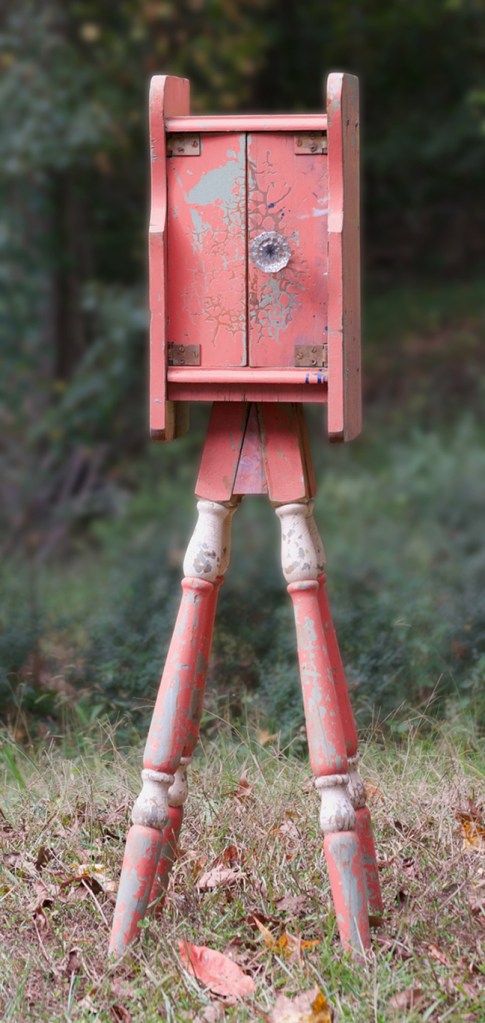
I cut it apart and reassembled the salvageable pieces into a kind of small cabinet on legs.
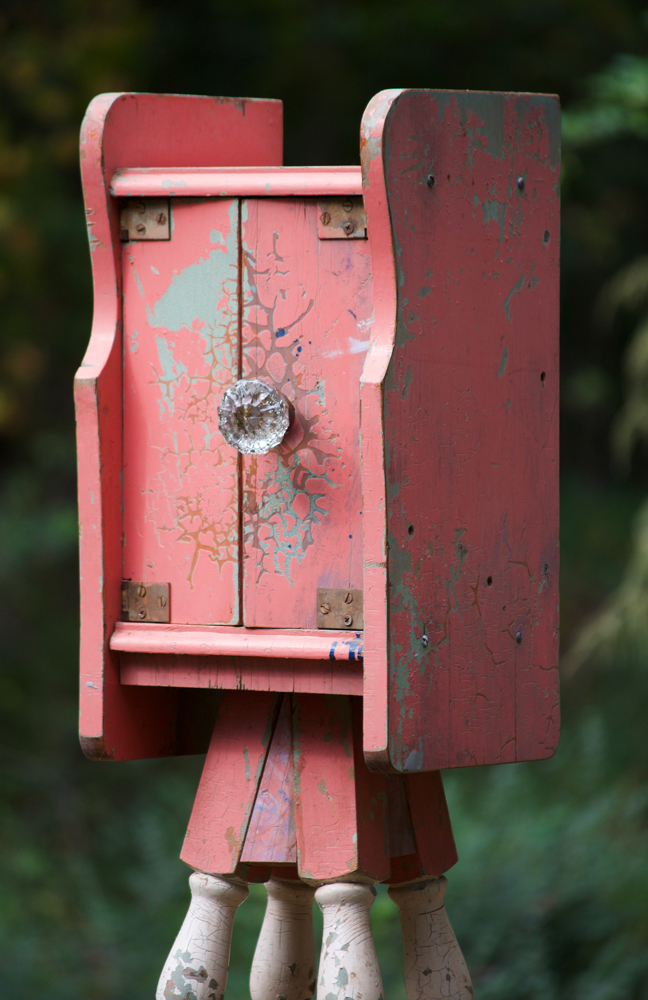
I refashioned the table’s drop-leafs and reused its hinges for doors and affixed an old glass doorknob to one door.

Turns out, the little cabinet was exactly the width of an old set of encyclopedias my mother bought in the 1940s. Entitled “The New Wonder Book Cyclopedia of World Knowledge,” they are what give the piece its title. The books’ spines are black with gold-stamped art deco designs of a ship, a modern train in a big city, and a rocket ship. The books “float” over a collection of broken sticks and twigs painted flat black.
I lived most of my life through the second half of the twentieth century. For me, this is something of a nostalgic piece. The old, busted-up table reformed into a scarred little cabinet recalls that busted-up century. The books look back to what we now call the Modern Era, with its progressive visions of knowledge conquering even the stars. The blackened sticks were an intuitive addition. They might represent the dark nature underlying hopes and dreams—experienced too often in that century—or perhaps something of our natural, perhaps unconscious “shadow” foundation. Who knows?
The fun in a representational painting is seeing something new in a recognizable image. The fun in assemblages is discovering something unseen in a fresh juxtaposition of recognizable things.
 art by skip johnston