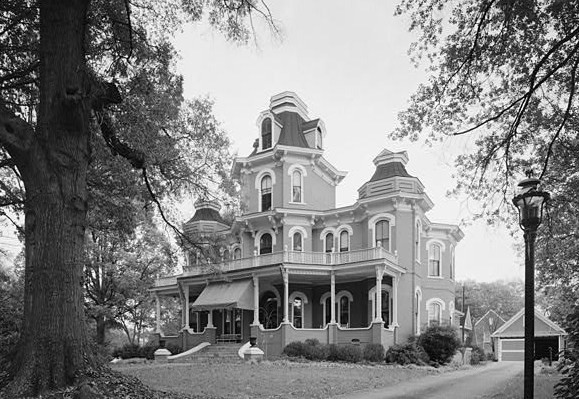
Photographer: Jack E. Boucher, Library of Congress, Historic American Buildings Survey
The Lanneau-Norwood House on the south side of Greenville is listed in the National Registry of Historic Homes. Built in 1877 by Charles H. Lanneau, it’s considered an outstanding example of the Second Empire style. John W. Norwood purchased the estate in 1907. Although the surrounding acreage has been sub-divided and developed, the House continues as a private residence for his descendants.
The House holds court atop a slight rise on Belmont Street. Attractive, early 20th century homes populate the surrounding neighborhood. But with her four-story central tower, substantial proportions, and bold salmon-with-white-trim color scheme, the Lanneau-Norwood House is clearly matriarch of the area.
I’ve been commissioned to paint her “portrait”.
Designing the portrait of a recognizable place in my particular “cut out, dimensional” style presents some fun challenges. Because our visual minds read the edges of shapes first and then fills in interior detail, the silhouette of cut-outs and their relationship to each other is important. The Lanneau-Norwood House is a complex arrangement of geometric shapes with a very active silhouette. She is already an interesting work of art.
Like the portrait of a person, I have to capture her likeness and say something about her character.

Artist Edward Rice's painting of Greenville's Downtown Baptist Church.
I could offer several approaches. I could “zoom in” on a signature architectural detail—say, the central tower—and allow it to speak for the whole. I love Edward Rice’s photo- realistic, close-up portraits of Greenville landmarks. Each painting is a jewel set in a sensitively cropped frame that invites the viewer to identify or imagine the complete structure. But making a dimensional piece from a detail necessitates literally cutting away the rest of the house. It might be an interesting painting. But it’s not a complete portrait.
I could take an odd or distorted angle, which might add expressive dynamism but risks a fight with the House’s native aesthetic.
I could contain her within a rectangle—in effect frame her like a typical painting. The lovely 1930’s photo above is a nice example. But framing would defeat the idea of an active silhouette.
The House has her own very strong visual opinions on how she should be presented. She is aggressively symmetrical. As much complex detail as she holds across her four stories, wide front porch, various angles, and multiple windows, the left side strongly mirrors the right and the central tower anchors everything. By moving the point of view even slightly to one side or the other in a dimensional painting, important details begin to disappear or become confused with closer detail. The House’s design intends a view straight on from the approaching walkway. Today, as the neighborhood has grown up around her, you must approach the House from an angle along the street. You don’t get a full, satisfying view until standing directly in front. Keep in mind that a cut out silhouette will appear flattened at first to the visual mind. Only when the House’s intended symmetry is fully seen does her most descriptive silhouette lock into view.
Frankly, I’m an asymmetrical kind of guy. I like the dynamic tension and visual surprise in things being off kilter. It’s why I enjoy making paintings that break the frame. My aesthetic impulse is to do the painting from a chopped, cropped, or distorted point of view. (And I may very well explore these possibilities on my own.) Such renditions might say more about my character than that of the Lanneau-Norwood House. Her character, though bold, is stately.
So, just as the House insists, the painting will be a full frontal, symmetrical representation.
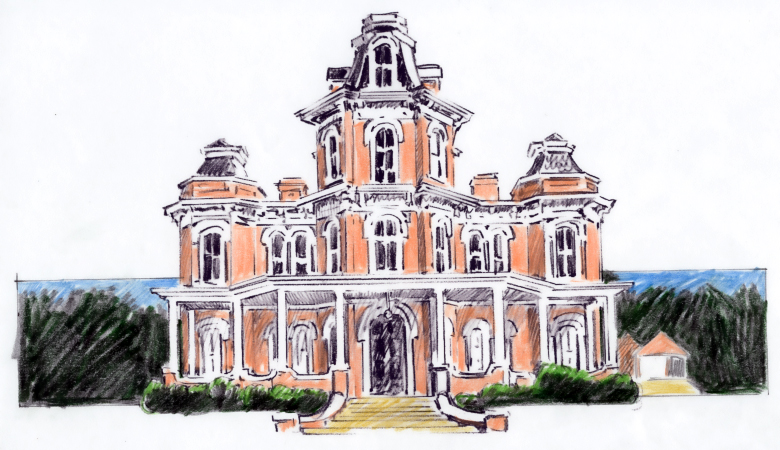
Final pencil sketch for Lanneau-Norwood house painting.
To anchor this and emphasize dimension, a long horizontal rectangle (really smaller rectangles on each side) will visually run across behind. The simple 90° angles of this background shape compliment the complex silhouette in front and, in effect, make an imaginary “frame” from which the House is emerging. I’ll paint scenery behind the house on these suggesting her environment. Reflecting her personality, the painting of the Lanneau-Norwood House will be too big for its frame.
Design done! Next, the drawing.
 art by skip johnston
What a fun project. I can’t wait to see your final interpretation!
LikeLike
Skip, I saw your painting; it is absolutely fantastic! You caught the home perfectly – and your work is wonderful!
LikeLike
Thanks, so much. It’s a lot of fun to work with a great subject!
LikeLike